- September 10, 2026
Water Conditioners for Poultry Farms: Role & Benefits
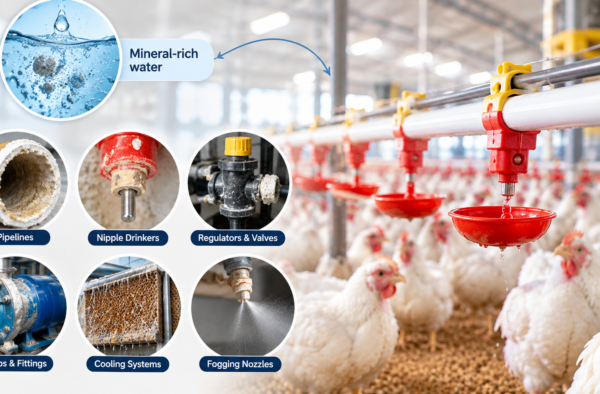
Water quality plays an important role in maintaining an efficient poultry water system. Water Conditioners for Poultry Farms can help manage hard-water-related scaling and reduce the tendency of mineral deposits to accumulate inside pipelines, nipple drinkers, valves, and other water-system components.
Hard water commonly contains dissolved minerals such as calcium and magnesium. When these minerals accumulate over time, they can contribute to scale formation and affect the performance of poultry water infrastructure.
Understanding how water conditioners work, where they can be used, and how they fit into a complete water-management strategy can help poultry farmers make better decisions for their farms.
What Is a Water Conditioner?
A water conditioner is a system designed to modify certain characteristics or behavior of water without necessarily removing all dissolved minerals from it.
In poultry farming, water conditioners can be used as part of a broader water-management strategy, particularly where hard water and mineral scaling are recurring concerns.
The exact working principle depends on the type of conditioning technology used.
Some systems are designed to alter the way scale-forming minerals behave, helping reduce their tendency to form hard deposits on water-system surfaces.
Why Do Poultry Farms Need Water Conditioning?
Poultry farms often depend on long water pipelines and automated drinking systems to distribute water across large areas.
When the source water contains significant amounts of hardness-forming minerals, repeated exposure can contribute to mineral deposits.
Over time, this may affect:
- Water pipelines
- Nipple drinkers
- Regulators
- Valves
- Fittings
- Filters
- Pumps
- Fogging systems
- Cooling equipment
Water conditioning can therefore be considered as one part of a preventive strategy for managing mineral-related problems.
How Water Conditioners Help Manage Hard Water
The main objective of a water conditioner is not necessarily to make hard water chemically identical to soft water.
Depending on the technology, conditioning may instead influence how dissolved minerals interact with surfaces and how readily they form persistent scale.
This distinction is important because water conditioning and conventional water softening are not always the same process.
A suitable conditioner should be selected according to the farm’s water characteristics, equipment, operating conditions, and specific scaling concerns.
Key Benefits of Water Conditioning in Poultry Farms
1. Helps Control Mineral Scale
One of the primary reasons poultry farms consider water conditioning is to help manage mineral scale.
Controlling excessive scale formation can help keep water-system components functioning more consistently.
2. Supports Water-Line Performance
Mineral deposits can gradually accumulate inside water pipelines.
By helping manage scale formation, conditioning can support the long-term performance of the water-delivery system.
3. Helps Protect Small Water Components
Nipple drinkers, valves, regulators, and other components often have relatively small internal passages.
Mineral deposits in these areas can interfere with normal operation. Scale control can help reduce this type of buildup.
4. Can Reduce Scale-Related Cleaning
Where recurring mineral deposits are a major problem, controlling scale formation may reduce the frequency or intensity of scale-related cleaning and intervention.
However, routine water-system cleaning should still remain part of farm management.
5. Supports Equipment Protection
Water systems contain numerous components that continuously come into contact with farm water.
Managing mineral deposits can help reduce one source of stress on pipelines and equipment and may contribute to better system longevity.
Water Conditioner vs Water Softener
The terms water conditioner and water softener are sometimes used interchangeably, but they can refer to different approaches.
A conventional water softener generally uses an ion-exchange process to reduce calcium and magnesium hardness.
A water conditioner may use a different technology to influence scale formation without necessarily removing the hardness minerals from the water.
Therefore, poultry farmers should look beyond the product name and understand:
- What technology is being used?
- Does it remove hardness or manage scaling?
- Is salt required?
- Are chemicals added?
- What type of water is it designed for?
- What flow rate can it handle?
- Is it suitable for the farm’s existing water system?
Choosing the right technology is more important than simply choosing between the labels “conditioner” and “softener.”
Where Can Water Conditioners Be Used?
Depending on the system design and application, water-conditioning solutions may be considered for several poultry-farm water systems.
Poultry Drinking-Water Lines
Water conditioners can help manage mineral scaling in pipelines supplying nipple drinkers.
Nipple Drinking Systems
Scale management can be particularly relevant for systems containing small water outlets and moving components.
Cooling Systems
Hard water can contribute to mineral deposits in cooling-related equipment. Appropriate scale-control solutions may help manage this issue.
Fogging Systems
Fine nozzles used in fogging systems can be sensitive to deposits. Water conditioning may be considered where mineral buildup is affecting nozzle performance.
Farm Water Pipelines
Long pipelines can gradually accumulate mineral deposits when exposed to hard water. Conditioning can form part of a preventive scale-management strategy.
Water Conditioning Is Not a Replacement for Water Management
Installing a water conditioner does not eliminate the need for proper poultry water-system management.
A complete approach should include:
Water Assessment → Scale Control → Regular Inspection → System Cleaning → Performance Monitoring
Farm operators should continue monitoring the condition of pipelines, drinkers, filters, regulators, and other components.
If a water system already has heavy deposits, existing scale may also require appropriate cleaning or mechanical intervention. Conditioning is primarily a tool for managing the ongoing scaling tendency and should not be viewed as a universal substitute for cleaning.
How to Choose a Water Conditioner for a Poultry Farm
Before selecting a system, consider the actual requirements of the farm.
Check the Water Source
Understand whether the farm uses borewell, municipal, surface, or another water source.
Assess Water Hardness
Testing the water helps establish the level of hardness and provides a basis for selecting an appropriate treatment or conditioning approach.
Consider Flow Rate
The conditioner should be capable of handling the water demand of the farm without becoming a restriction in the system.
Consider the Entire Water System
Look beyond the drinking line. If the farm also has cooling pads, fogging systems, storage tanks, or other water-dependent equipment, the overall water network should be considered.
Understand the Operating Requirements
Farm operators should know whether the system requires electricity, consumables, chemicals, salt, replacement components, or regular servicing.
MR WATER Anti-Scale X for Poultry Water Systems
MR WATER Anti-Scale X is an electrolysis-based water-conditioning solution designed for scale control without conventional salt-based softening.
For poultry applications, the system can be considered where hard water and recurring mineral scaling are creating challenges in pipelines, nipple drinkers, cooling systems, or other water-related equipment.
Its purpose is to help manage scale formation while supporting the continued operation of the farm’s water infrastructure.
The right installation should always be based on the farm’s water characteristics, flow requirements, and specific operating conditions.
A Preventive Approach to Poultry Water Management
Water conditioners should not be viewed as a standalone solution to every poultry water problem.
Their greatest value comes when they are integrated into a broader preventive water-management program.
Regular testing, inspection, cleaning, appropriate filtration, and scale control can work together to keep the water system in better operating condition.
For farms dealing with persistent hard-water scaling, addressing the problem at the water-management level can be more practical than repeatedly dealing with individual blocked or scaled components.
Frequently Asked Questions
What is the role of a water conditioner in poultry farming?
A water conditioner can help manage the effects of hard water, particularly the tendency of dissolved minerals to form scale inside pipelines and water-system components.
Does a water conditioner remove hardness from water?
Not necessarily. The result depends on the technology. Some conditioners focus on managing scale formation rather than removing calcium and magnesium from the water.
Is water conditioning the same as water softening?
No. Conventional water softening commonly uses ion exchange to reduce hardness, while water-conditioning technologies may work differently and focus on scale control.
Can water conditioners help poultry nipple drinkers?
They can help manage mineral scaling that may accumulate around or inside nipple-drinking systems. However, existing heavy deposits may still require proper cleaning.
Do poultry farms still need to clean water lines after installing a conditioner?
Yes. Water conditioning does not replace routine water-line hygiene and maintenance. Existing deposits and other contaminants may require separate cleaning procedures.
Is water conditioning suitable for every poultry farm?
Cleaning frequency depends on water quality, equipment, farm conditions, and the farm’s sanitation program. Regular inspection helps determine when cleaning or flushing is necessary.
Conclusion
Hard water can create long-term challenges for poultry water systems, particularly when mineral deposits begin accumulating throughout pipelines and equipment.
Water conditioners for poultry farms can provide a preventive approach to managing scale formation and protecting the performance of water-delivery infrastructure.
The key is to treat water conditioning as part of a complete management strategy—not as a replacement for testing, cleaning, inspection, or proper system maintenance.
Better Water Management Starts Before Scale Becomes a Problem.