- October 10, 2026
How Mineral-Rich Water Affects Poultry Farm Equipment
Water is an essential part of every poultry farm, but its mineral content can influence how water systems and equipment perform over time. Mineral-rich water in poultry farms may contain elevated levels of calcium, magnesium, iron, and other dissolved minerals that can gradually leave deposits inside water-handling equipment.
These deposits may not cause problems immediately. However, continuous exposure can affect water flow, equipment performance, and maintenance requirements.
What Is Mineral-Rich Water?
Mineral-rich water contains naturally occurring dissolved minerals. Groundwater and borewell water can sometimes contain higher mineral concentrations depending on local geology.
Common minerals found in water include:
- Calcium
- Magnesium
- Iron
- Manganese
- Other dissolved minerals
The actual composition varies from one water source to another, which is why testing the farm’s water is an important first step.
How Can Minerals Affect Poultry Farm Equipment?
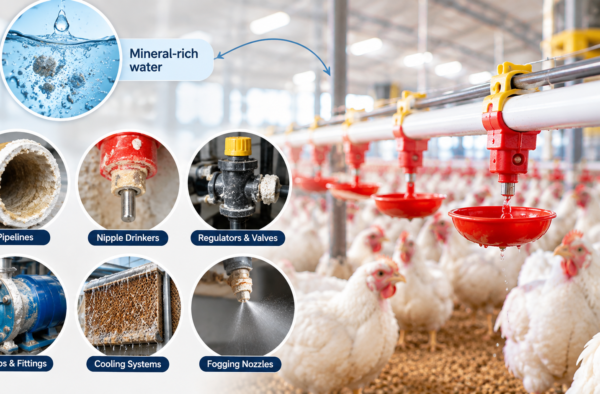
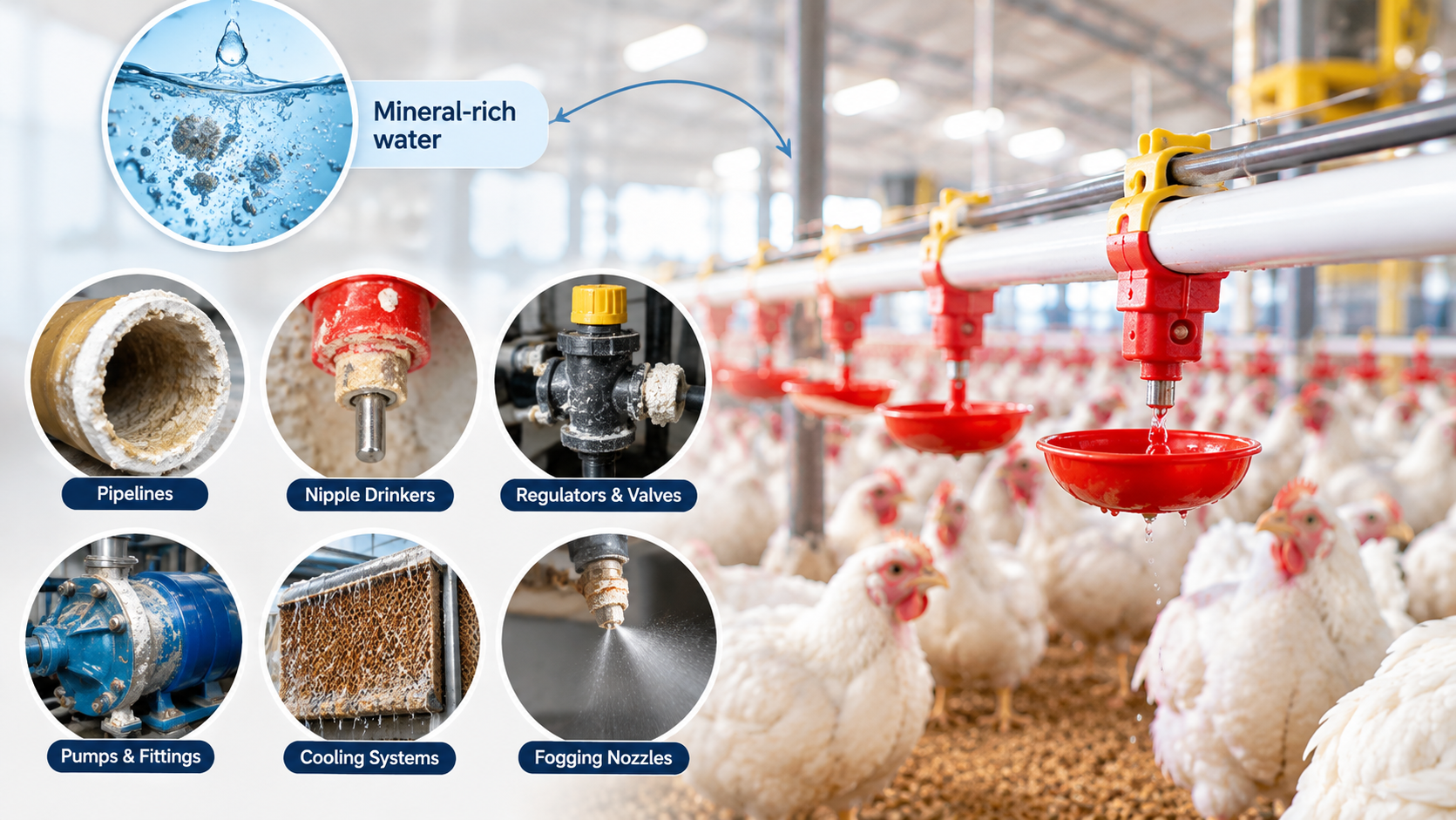
When mineral-rich water continuously passes through pipes, valves, drinkers, pumps, and other components, deposits can gradually accumulate on internal surfaces.
Over time, this may contribute to:
- Restricted water passages
- Reduced flow
- Deposits around fittings
- Blocked small openings
- Increased cleaning requirements
- More frequent equipment maintenance
The impact depends on the water chemistry, equipment design, operating conditions, and duration of exposure.
1. Water Pipelines
Poultry water pipelines carry water continuously throughout the farm. Mineral deposits can gradually accumulate along the internal surfaces of these lines.
As deposits increase, the available passage for water can become smaller, potentially affecting flow through parts of the system.
Regular inspection and appropriate water-line maintenance can help identify these problems early.
2. Nipple Drinking Systems
Nipple drinkers contain small water passages and moving components. Mineral deposits can interfere with their operation if buildup becomes significant.
Possible signs include:
- Reduced water delivery
- Restricted movement
- Dripping
- Uneven flow
- Visible mineral deposits
Keeping drinking systems clean and monitoring their performance can help prevent small problems from developing into larger system issues.
3. Regulators and Valves
Regulators and valves control water movement and pressure throughout a poultry drinking system.
Mineral deposits can accumulate around internal components and narrow passages, potentially affecting their performance.
Regular inspection is particularly useful when the farm’s water source is known to contain high mineral levels.
4. Pumps and Fittings
Pumps, connectors, joints, and other water-system components are also exposed to the farm’s water chemistry.
Mineral deposits can accumulate on surfaces and connections, increasing the need for cleaning and maintenance.
Proper filtration and scale-management practices can help support the long-term operation of these components.
5. Cooling Systems
Poultry cooling systems use significant amounts of water, making water quality an important consideration.
Mineral-rich water can contribute to deposits on water-distribution components, including pipes and nozzles.
Over time, buildup may affect water distribution and increase maintenance requirements.
6. Fogging Nozzles
Fogging systems often use small nozzles to produce fine water droplets. Because their openings are relatively small, mineral deposits can become a concern when water contains high levels of scale-forming minerals.
Regular inspection and appropriate water treatment can help maintain nozzle performance.
Why Does Mineral Buildup Happen?
Mineral buildup can be influenced by several factors:
Mineral concentration + water chemistry + temperature + continuous use + system conditions
This means two poultry farms using different water sources may experience very different levels of mineral buildup.
Borewell water, for example, can have a different mineral profile from surface or treated water.
How Can Poultry Farms Manage Mineral-Rich Water?
A practical approach starts with understanding the water and then maintaining the entire water system.
Test the Water
Regular testing can help identify hardness, TDS, pH, and other relevant parameters.
Monitor Equipment
Check pipelines, drinkers, valves, pumps, cooling systems, and fogging nozzles for deposits or changes in performance.
Flush Water Lines
Appropriate flushing can help remove accumulated material from water lines. The procedure and frequency should follow the system design and equipment recommendations.
Maintain Filters
Filters should be inspected and maintained according to the manufacturer’s recommendations to prevent unnecessary restrictions in the system.
Consider Water Conditioning
When mineral scaling is a recurring problem, water conditioning can be considered as part of a broader scale-management strategy.
MR WATER uses electrolysis-based water-conditioning technology designed to help reduce the tendency of hardness-forming minerals to create persistent scale deposits.
Water Conditioning vs Equipment Maintenance
Water conditioning should not be viewed as a replacement for routine maintenance.
A complete poultry water-management approach can combine:
Water Testing → Filtration → Conditioning → Flushing → Inspection
Each step addresses a different part of the water-system management process.
Signs Your Equipment May Need Attention
Poultry farms should investigate their water system when they notice:
- Reduced water flow
- Frequent drinker blockages
- White or chalky deposits
- Changes in water pressure
- Clogged fogging nozzles
- Repeated valve problems
- Increased cleaning frequency
- Mineral deposits inside pipelines
Identifying these signs early can help prevent more extensive maintenance problems.
Conclusion
Mineral-rich water in poultry farms can gradually affect water pipelines, nipple drinkers, regulators, pumps, cooling systems, fogging nozzles, and other water-handling equipment.
The best approach is proactive: understand the water source, monitor equipment, maintain water lines, and address recurring mineral-scaling problems appropriately.
For farms dealing with persistent hard-water scaling, water conditioning can be an additional tool for managing mineral deposits and supporting the performance of poultry water infrastructure.
Better Water Management Starts With Understanding Your Water.
MR WATER — Solutions for Better Poultry Water Systems.