
- September 3, 2026
How Water Quality Can Increase Poultry Farm Maintenance Costs
Poultry farm maintenance is often associated with buildings, ventilation systems, feeders, electrical equipment, and climate-control systems. However, one area that can quietly increase maintenance expenses is the farm’s water infrastructure.
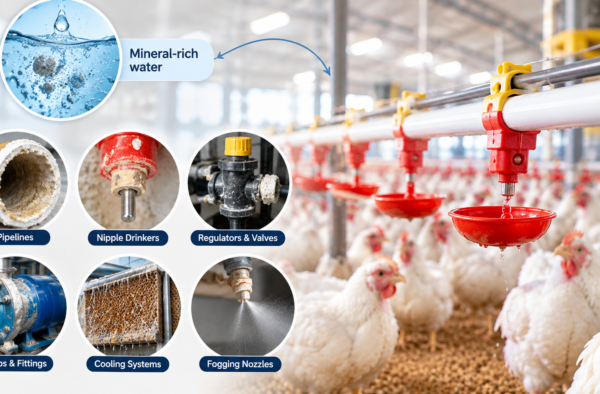
The drinking-water system operates continuously. Pipes, valves, filters, regulators, nipple drinkers, tanks, and other components remain exposed to the water flowing through the farm every day.
When that water carries excessive minerals or suspended material, deposits can gradually develop inside the system. What begins as a small maintenance issue can eventually turn into repeated cleaning, component replacement, labour, and operational downtime.
This makes poultry farm water maintenance an important part of controlling long-term farm operating costs.
Where Do Water-Related Maintenance Costs Come From?
Water-related expenses are not limited to buying or treating water.
The bigger cost can come from maintaining the infrastructure that delivers it.
A typical poultry drinking system may include:
Source → Pump → Storage → Filter → Main Line → Regulators → Distribution Lines → Drinkers
Each component has a role to play. Problems developing at one point can create additional pressure on other parts of the system.
For example, mineral deposits can gradually restrict a pipeline. Restricted flow can place greater attention on regulators and drinkers, while blocked components require additional inspection and cleaning.
1. Scale Creates a Maintenance Burden
One of the most persistent problems associated with hard water is mineral scale.
As water passes through pipes and equipment, minerals can accumulate on internal surfaces. Over time, deposits can become thick enough to interfere with components.
The problem is not simply the presence of scale.
The maintenance burden comes from having to repeatedly:
- Inspect affected sections
- Flush the system
- Clean components
- Remove deposits
- Check water flow
- Replace severely affected parts
On a small farm, this may be manageable. On a large commercial operation with extensive water lines, the same issue can become a recurring maintenance task.
2. Small Components Can Become the Biggest Problem
A poultry water system contains many relatively small components, but their numbers can be significant.
Nipple drinkers, connectors, valves, filters, regulators, and fittings can all require attention when deposits or debris enter the system.
Instead of one major repair, farmers may experience many smaller maintenance jobs over time.
This creates a hidden cost:
More components to inspect + more cleaning + more replacements = higher maintenance workload
Preventing recurring buildup can therefore be more practical than repeatedly repairing individual components.
3. Labour Costs Add Up
Maintenance is not only about spare parts.
Someone has to identify the problem, shut down or isolate the relevant section, inspect the equipment, clean or replace components, and restore the system.
When water-system problems occur frequently, farm workers spend more time on maintenance instead of routine farm activities.
For larger operations, repeated maintenance across multiple poultry houses can make labour requirements even more significant.
4. Water-Line Cleaning Takes Time
Water lines require proper cleaning and flushing as part of good farm management.
However, the amount of effort required can increase when the system regularly develops mineral deposits or other buildup.
A line that is difficult to clean may require:
- More frequent flushing
- Additional inspection
- Component removal
- Manual cleaning
- Longer maintenance sessions
The objective should therefore be to keep the system in a condition where routine maintenance remains manageable.
5. Filters May Require More Frequent Attention
Filters are installed to help manage particles and protect downstream equipment.
When the incoming water contains significant suspended material, filters can become loaded more quickly.
This may result in more frequent inspection, cleaning, or replacement.
Filter maintenance should therefore be considered when calculating the overall cost of managing a poultry water system.
6. Restricted Flow Can Create Troubleshooting Costs
Water-flow problems can be difficult to identify immediately.
A farm may notice that some drinkers are not performing correctly, but the underlying issue could be located elsewhere in the system.
Farm staff may then need to inspect multiple sections to determine whether the problem is related to:
- Mineral deposits
- Blocked filters
- Pressure regulation
- Pipeline restrictions
- Damaged fittings
- Drinker components
The longer it takes to locate the cause, the greater the maintenance effort can become.
7. Equipment Replacement Is More Expensive Than Routine Maintenance
Regular inspection and cleaning are generally easier to manage than replacing large sections of equipment.
Repeated exposure to problematic water conditions can contribute to maintenance challenges involving pipes, valves, regulators, drinkers, and other components.
Replacement costs may include more than the part itself.
Farmers may also need to account for:
Parts + Labour + Installation + System Downtime
For this reason, extending the useful life of water-system components can be an important maintenance objective.
8. Downtime Has an Operational Cost
Water-system maintenance sometimes requires sections of the system to be taken offline.
Even when the repair itself is relatively simple, workers may need time to isolate the affected section, carry out the repair, test the system, and restore normal operation.
On larger poultry farms, maintenance activities may need to be coordinated across multiple houses.
Reducing recurring water-system problems can therefore help make farm operations more predictable.
9. The Cost Is Often Hidden in Several Departments
One reason water-quality-related maintenance can be overlooked is that the cost is spread across different areas.
For example:
| Cost Area | Possible Impact |
|---|---|
| Labour | More time spent on cleaning and repairs |
| Spare Parts | More frequent component replacement |
| Cleaning | Additional maintenance activities |
| Filters | Increased inspection or replacement |
| Equipment | Reduced service life |
| Downtime | Temporary interruption during repairs |
| Management | More time spent troubleshooting |
Individually, these costs may appear small. Together, recurring issues can become a significant operating expense.
How Can Poultry Farms Control Water Maintenance Costs?
The most effective approach is usually proactive maintenance rather than waiting for a failure.
Inspect the System Regularly
Check pipelines, drinkers, filters, valves, regulators, tanks, and fittings for visible buildup or performance problems.
Track Recurring Repairs
If the same drinkers, filters, or sections of pipeline repeatedly require attention, investigate the underlying cause.
Monitor Water Characteristics
Testing the source water can help identify mineral or other water-quality characteristics that may contribute to maintenance challenges.
Maintain Storage and Distribution Equipment
Keeping tanks and distribution components properly maintained helps prevent avoidable problems further down the system.
Address Scale Before It Becomes Severe
If hard-water scale is repeatedly affecting the system, investigate suitable scale-management or water-conditioning options rather than relying only on repeated manual cleaning.
Can Water Conditioning Help Reduce Scale-Related Maintenance?
Where hard-water scale is a recurring problem, water conditioning can be considered as part of a preventive maintenance strategy.
MR WATER Anti-Scale X is designed to help control hard-water scale using electrolysis-based technology without adding conventional chemicals or salt.
For poultry applications, such technology can be considered alongside regular inspection, cleaning, water testing, and equipment maintenance.
The appropriate solution should always be selected based on the farm’s water characteristics, system design, and operating conditions.
A Simple Way to Think About Water Maintenance Costs
Instead of looking only at the cost of repairing a damaged component, farmers can consider the complete maintenance cycle:
Water Quality → Mineral/Sediment Buildup → System Performance Issues → Inspection → Cleaning → Repairs → Replacement
If the same cycle keeps repeating, the farm is paying for the same problem multiple times.
A preventive approach aims to interrupt that cycle before maintenance becomes excessive.
Build a Preventive Water-Maintenance Checklist
A simple checklist can help farm teams stay ahead of recurring problems.
Weekly Checks
- Inspect visible leaks
- Check drinker performance
- Observe water pressure
- Look for unusual deposits
Routine Checks
- Inspect filters
- Examine tanks
- Check regulators and valves
- Review water-consumption records
- Inspect sections of water lines
Periodic Checks
- Test source water
- Review hardness and mineral content
- Evaluate recurring equipment failures
- Assess the condition of pipelines and drinkers
- Review whether current scale-control measures are effective
The exact maintenance schedule should be adapted to the farm’s water source, equipment, and operating conditions.
Why Preventive Water Maintenance Makes Business Sense
A poultry farm does not need to wait until a water line becomes severely restricted or a large number of drinkers require replacement.
Identifying recurring problems early gives farmers an opportunity to plan maintenance, manage spare parts, reduce emergency repairs, and improve the reliability of the drinking system.
The goal is simple:
Less Reactive Maintenance → Fewer Unexpected Problems → Better Control of Operating Costs
Frequently Asked Questions
What is poultry farm water maintenance?
Poultry farm water maintenance involves inspecting, cleaning, servicing, and managing the equipment used to store and deliver drinking water, including tanks, pipes, filters, regulators, valves, and drinkers.
How does hard water increase maintenance costs?
Hard water can contribute to mineral scale inside water lines and equipment. Significant buildup may require additional cleaning, inspection, repairs, or component replacement.
What are the hidden costs of poor water-system maintenance?
Hidden costs can include additional labour, cleaning requirements, spare parts, equipment replacement, troubleshooting time, and operational downtime.
How can farmers reduce water-system maintenance?
Regular inspection, appropriate cleaning, water testing, equipment servicing, and early management of recurring scale or sediment problems can help control maintenance requirements.
Is water conditioning a replacement for cleaning?
No. Water conditioning can be one component of a broader water-management strategy. Regular cleaning, inspection, sanitation, and maintenance remain important.
Conclusion
Water quality can influence much more than what reaches the poultry drinker. It can also determine how much time, labour, and money a farm spends maintaining its water infrastructure.
Mineral scale, sediment, and other water-related issues can gradually create additional work across pipelines, filters, valves, regulators, and drinkers.
By treating poultry farm water maintenance as a preventive management priority, farmers can identify recurring problems earlier, plan maintenance more effectively, and avoid unnecessary repair and replacement expenses.
Protect the Water System Today. Reduce Maintenance Problems Tomorrow.