- October 15, 2026
Hard Water in High-Rise Apartments: What Residents Should Know
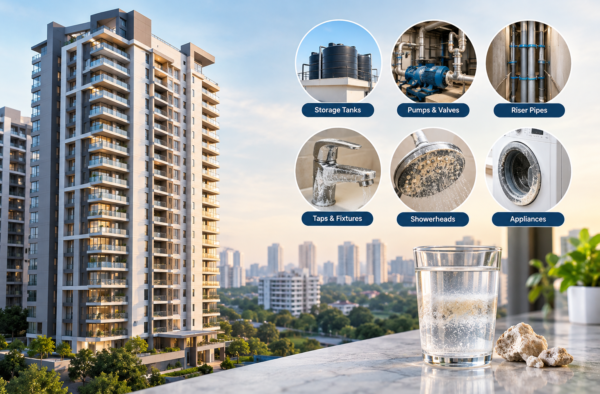
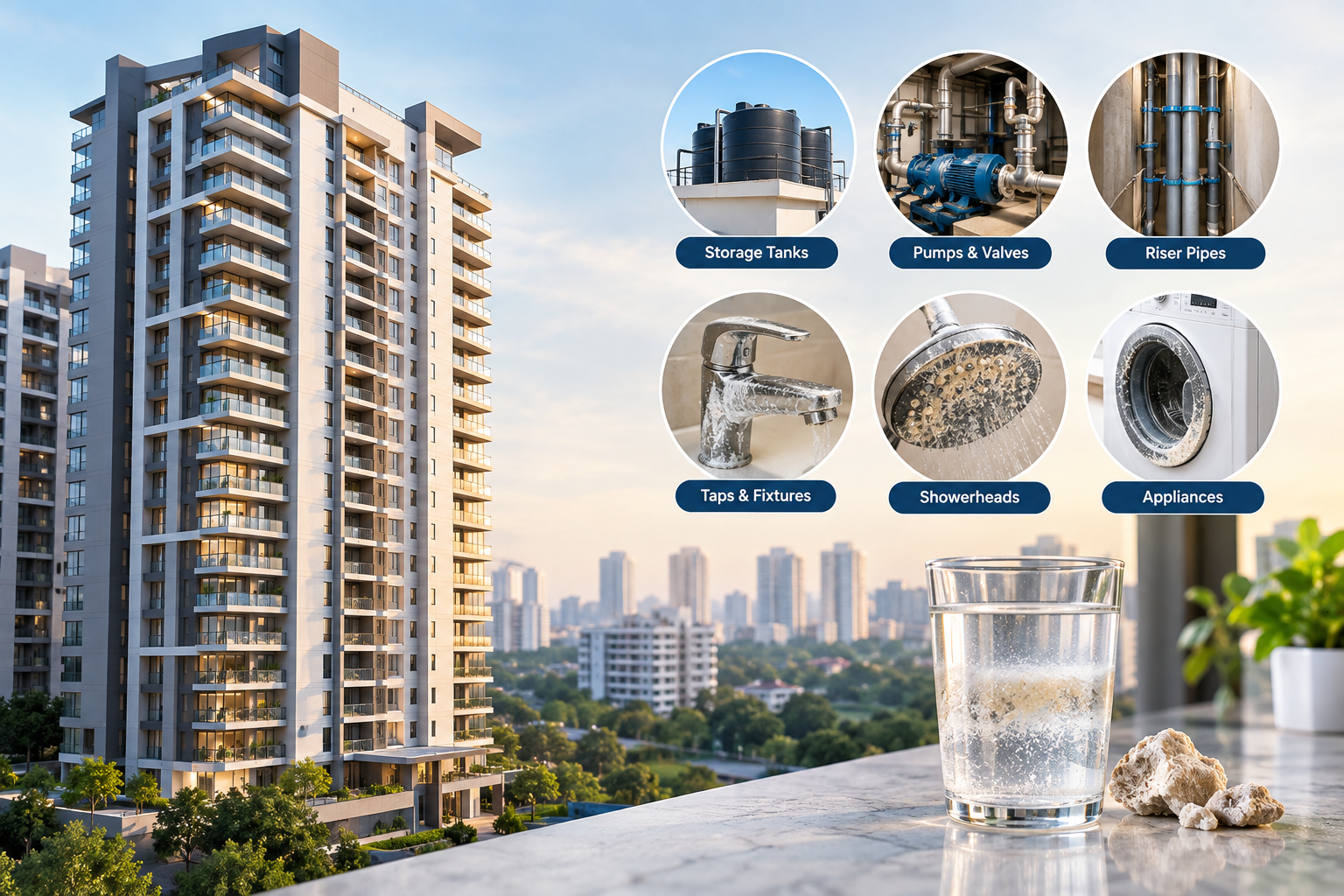
Hard Water in High-Rise Apartments can create a different set of challenges compared with independent houses. Water may pass through shared storage tanks, pumps, risers, distribution pipelines, and individual apartment plumbing before reaching taps and appliances.
Because many residents depend on the same building water infrastructure, understanding how hard water behaves in a high-rise can help residents and apartment management teams make better decisions about water conditioning and maintenance.
Why Is Hard Water Common in High-Rise Apartments?
Many high-rise buildings depend on groundwater, borewell water, municipal water, or a combination of sources. The mineral content can vary significantly depending on the source and location.
Hard water generally contains higher levels of dissolved calcium and magnesium.
In a high-rise building, this water may travel through:
- Underground or basement storage tanks
- Overhead tanks
- Transfer pumps
- Booster pumps
- Vertical riser pipes
- Floor-level distribution lines
- Apartment plumbing
- Taps and fixtures
The longer and more complex the distribution network, the more important it becomes to understand the water entering the building.
How Can Residents Recognize Hard Water?
Residents may notice signs such as:
- White marks around taps
- Mineral deposits on bathroom fixtures
- Spots on glass surfaces
- Deposits around faucet aerators
- Reduced performance of some water outlets
- Soap or detergent behaving differently
- Frequent cleaning of bathroom fixtures
These signs alone cannot confirm water hardness, but they can indicate that the building’s water quality deserves closer attention.
Does Every Apartment Experience Hard Water the Same Way?
Not necessarily.
Apartments on different floors or in different sections of a building may experience variations in water pressure and flow because of the building’s distribution design.
However, this does not automatically mean that water hardness is different on every floor. Mineral content is primarily related to the water source and treatment process.
Differences noticed between apartments can also result from:
- Pressure variations
- Plumbing configuration
- Localized deposits
- Fixture condition
- Building water-system design
This distinction is important when investigating a water-related problem.
How Hard Water Can Affect Shared Building Infrastructure
High-rise buildings have extensive water infrastructure, and mineral deposits can accumulate in components exposed to hard water over long periods.
Potential areas of concern include:
Storage and Distribution Systems
Water tanks and distribution networks are important parts of the building’s water infrastructure. Regular inspection and appropriate maintenance can help identify deposits and other issues.
Pumps and Valves
Pumps, valves, regulators, and fittings are repeatedly exposed to the building’s water. Mineral deposits may contribute to maintenance requirements over time.
Building Pipelines
Long vertical and horizontal pipelines transport water throughout the building. Where scale-forming conditions exist, deposits may gradually develop on internal surfaces.
Apartment Fixtures
Faucets, showerheads, aerators, and other outlets can show mineral deposits even when the building’s main water system appears to be functioning normally.
Why High-Rise Buildings Need a Different Approach
Treating hard water in an independent house and managing water quality in a high-rise are not the same challenge.
A high-rise may have:
One water source → Multiple tanks → Pumps → Multiple floors → Hundreds of outlets
This means a solution needs to consider the building-wide water system, not just an individual tap or appliance.
Apartment associations and facility-management teams should therefore evaluate the source water, building plumbing, water demand, and existing treatment infrastructure before selecting a solution.
Should Residents Install Individual Water Conditioners?
It depends on the building’s existing water-management system.
If the entire building has a common water-treatment or conditioning system, installing separate equipment inside every apartment may not always be necessary.
On the other hand, if the building does not have adequate whole-building scale management, individual or localized solutions may be considered for specific requirements.
The right approach should be based on:
- Water hardness
- Water source
- Building plumbing design
- Number of apartments
- Existing treatment systems
- Water usage
- Maintenance requirements
Whole-Building Water Conditioning
For apartment communities dealing with recurring hard-water scale, whole-building water conditioning can be considered as part of the building’s water-management strategy.
A properly selected system can be integrated into an appropriate point in the building’s water network, depending on the water-flow requirements and system design.
MR WATER’s Anti Scale X uses electrolysis-based technology designed to help manage the scaling tendency of hardness-forming minerals without conventional salt-based regeneration.
The objective is to help manage recurring scale throughout the water system rather than addressing deposits only after they appear on individual fixtures.
What Apartment Associations Should Check
Before choosing a hard-water solution, apartment management teams can review:
- Water Source – Borewell, municipal supply, or mixed source
- Water Hardness – Test the incoming water
- Existing Treatment – Check whether the building already has filtration or conditioning
- Storage System – Review tanks and associated equipment
- Water Distribution – Understand the building’s pipeline network
- Scale Problems – Identify where deposits are occurring
- Maintenance History – Review recurring cleaning and repair requirements
This provides a better foundation for choosing an appropriate water-management strategy.
Can Hard Water Be Managed Without Salt?
Yes, there are water-conditioning technologies that do not rely on conventional salt-based softening.
However, water conditioning and water softening are different approaches and should not be treated as identical technologies.
MR WATER Anti Scale X uses an electrolysis-based approach designed for scale management without conventional salt regeneration or chemical dosing.
The appropriate technology depends on the building’s water characteristics and specific requirements.
A Practical Approach for High-Rise Communities
A high-rise apartment can take a structured approach:
Test → Understand → Monitor → Condition → Maintain
Testing helps establish the water characteristics. Monitoring identifies recurring problems. Appropriate conditioning can help manage scale-forming conditions, while regular maintenance keeps the building’s water infrastructure operating properly.
Water conditioning should complement—not replace—proper water testing, cleaning, filtration, and plumbing maintenance.
Conclusion
Hard Water in High-Rise Apartments is not simply an individual household issue. Because apartment buildings share water infrastructure, hard-water management can involve storage tanks, pumps, pipelines, fixtures, and the overall distribution network.
For residents, recognizing the signs of hard water is a useful first step. For apartment associations, understanding the building’s water source and infrastructure can help identify a more practical long-term approach.
With proper testing, monitoring, maintenance, and suitable water-conditioning technology, apartment communities can take a more proactive approach to managing hard-water scale.
Better Water Management Starts at the Building Level.
MR WATER Anti Scale X — Advanced Scale Management for Modern Residential Water Systems.